

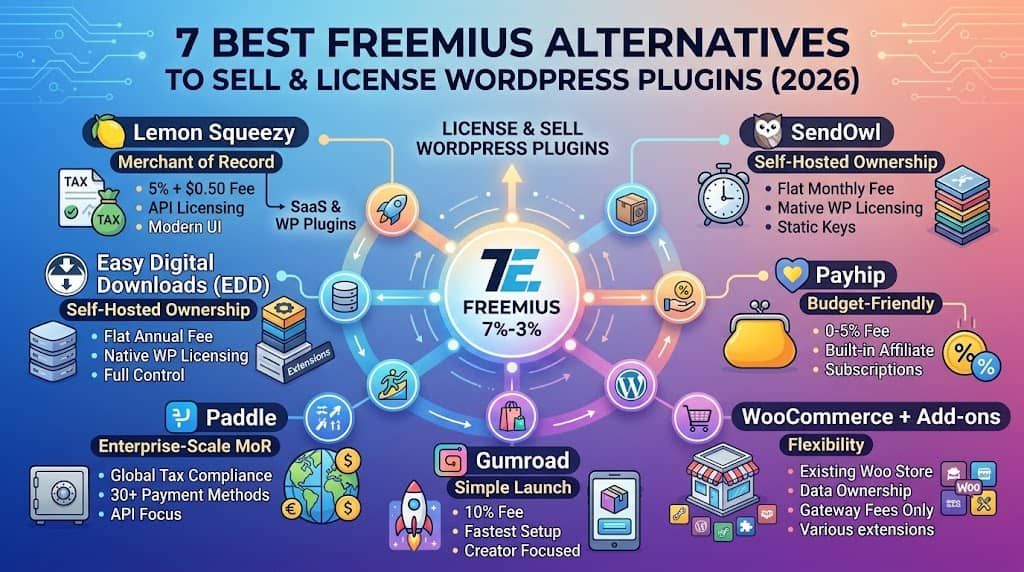
Why Developers Look for a Freemius Alternative
Freemius is, without question, the most purpose-built platform for WordPress plugin monetization on the market. Its SDK handles licensing, subscription renewals, EU VAT compliance, and freemium conversion flows out of the box — features that competitors simply don’t replicate at the same depth. Yet for a growing segment of WordPress developers, the search for a Freemius alternative is very real, and for completely understandable reasons.
The SDK itself adds significant weight to a plugin’s codebase. The 7% commission (dropping to 5% and then 3% at higher revenue tiers) can feel steep once a product is generating meaningful revenue and the marginal infrastructure cost is low. Some developers prefer to own their full payment stack — hosting their own checkout, managing their own customer database, and not depending on a third-party platform’s uptime or pricing decisions for their business continuity. Others simply already have a WooCommerce store and find it more natural to manage everything from their existing admin panel rather than jumping into a separate dashboard.
There’s also the question of product scope. Freemius is laser-focused on WordPress plugins and themes. If you’re building a product that spans WordPress and non-WordPress surfaces — or a SaaS tool that happens to include a WordPress integration — a more general-purpose platform may serve you better. Whatever your reason for exploring freemius alternatives for WordPress developers, this guide gives you a rigorous, up-to-date breakdown of every serious option available in 2026.
We’ll cover seven platforms in depth, including the most hotly discussed comparisons — Freemius vs Easy Digital Downloads and Freemius vs Lemon Squeezy — and we’ll help you pick the right tool for your specific situation by the end of this article.
Quick Comparison Matrix
Before diving into each platform, here’s the 30-second overview of how these best platforms to sell WordPress plugins compare across the metrics that matter most to developers:
MoR = Merchant of Record (platform handles tax remittance). ⚠️ = partial support via third-party add-on. *WooCommerce core is free; hosting, gateway, and add-on costs apply.
🍋
#1 — Lemon Squeezy
Best Merchant-of-Record Alternative
Lemon Squeezy is the freemius alternative that comes up most often in WordPress developer communities, and for good reason. It launched in 2021 with a razor-sharp focus on digital product sellers and indie SaaS developers — the exact audience that also gravitates toward Freemius. Like Freemius, it acts as a Merchant of Record, meaning it collects and remits sales taxes, EU VAT, and US state sales tax on your behalf. This alone removes an enormous compliance burden.
Lemon Squeezy’s pricing is transparent: a flat 5% + $0.50 per transaction with no monthly fee. For low-ticket plugins (e.g., $19–$29 products), the $0.50 fixed fee makes the effective rate higher than Freemius’s 7%. For high-ticket products ($99+), Lemon Squeezy becomes meaningfully cheaper. Its checkout experience is polished, its customer portal is clean, and the API is well-documented.
Where Lemon Squeezy falls short compared to Freemius for WordPress-specific developers is in native plugin licensing. Freemius’s SDK integrates directly inside your plugin and handles license key activation, deactivation, and validation transparently inside the WordPress admin. With Lemon Squeezy, you’d need to build this integration yourself using their Licenses API — it’s achievable, but it requires additional engineering effort and ongoing maintenance. There’s no official Lemon Squeezy WordPress SDK equivalent to the Freemius SDK.
✅ Pros
- Full Merchant of Record (global tax)
- 5% + $0.50 flat fee — no subscription cost
- Clean, modern checkout & customer portal
- Solid subscriptions and trial support
- License Keys API available
- Great for SaaS & digital downloads
⚠️ Cons
- No native WordPress SDK
- No built-in plugin telemetry / usage analytics
- No WooCommerce integration
- $0.50 fixed fee hurts low-ticket products
- No freemium conversion flow inside WP admin
Best for: Developers building SaaS tools that have a WordPress component, or plugin sellers whose product also works outside WordPress and want a single platform to manage all commerce.
⬇️
#2 — Easy Digital Downloads (EDD)
Best Self-Hosted Alternative
Easy Digital Downloads (EDD) is arguably the most established WordPress-native commerce platform for digital products. It powers a significant portion of the independent WordPress plugin marketplace, including several major plugin developers who run their own storefronts. As a comparison in the Freemius vs Easy Digital Downloads debate, EDD represents a fundamentally different philosophy: self-hosted ownership versus managed SaaS.
EDD runs on your own WordPress installation. You control your customer data, payment flow, checkout experience, and branding completely. The core plugin is free, and EDD’s licensing extension (Software Licensing) enables license key generation, activation limits, and update delivery via a custom update API — a genuine Freemius-comparable licensing system built natively in WordPress.
The catch, and it’s an important one when evaluating freemius alternatives for WordPress developers: EDD’s functionality requires a growing stack of extensions. Recurring subscriptions need the Recurring Payments add-on. EU VAT compliance requires a third-party plugin like EU VAT Assistant or Taxamo. Affiliate tracking requires a separate affiliate add-on. By the time you have a feature-comparable setup to Freemius, you’re paying $99–$299/year in EDD license fees plus potentially hundreds more in extension costs — and you’re managing all the infrastructure yourself.
That said, at scale — say, a plugin generating $10,000+ per month — EDD’s flat annual fee will always be cheaper than any percentage-based commission. If you’re willing to invest in setup and ongoing maintenance, EDD gives you maximum control and the lowest long-term transaction cost of any option on this list.
✅ Pros
- Full data ownership — your server, your DB
- No transaction commission at scale
- Native WordPress licensing via Software Licensing ext.
- Huge extension ecosystem
- Deeply customizable checkout & branding
- Battle-tested by thousands of plugin sellers
⚠️ Cons
- You manage hosting, security, and backups
- EU VAT compliance requires additional plugins
- No built-in usage analytics / telemetry
- Significant setup and maintenance overhead
- No dunning/renewal automation out of the box
- Annual extension costs add up quickly
Best for: High-revenue plugin developers ($8k+/month) who want to eliminate commission fees and are comfortable owning and managing their own commerce infrastructure long-term.
🏄
#3 — Paddle
Best for Enterprise-Scale Products
Paddle is the enterprise-grade SaaS commerce platform and one of the most powerful freemius alternative options for developers whose products have significant revenue. Like Freemius and Lemon Squeezy, Paddle operates as a Merchant of Record — it handles sales tax across 200+ countries, including EU VAT, UK VAT, Australian GST, and US state taxes. This global tax compliance coverage is broader than almost any other platform in this list.
Paddle’s pricing is identical to Lemon Squeezy: 5% + $0.50 per transaction. Its checkout experience is premium and highly conversion-optimized, with support for 30+ payment methods including PayPal, Apple Pay, Google Pay, and all major credit cards. Subscription management is a core strength — Paddle handles prorations, upgrades, downgrades, dunning, and cancellations with enterprise-level reliability. It also offers a powerful revenue recovery suite that automatically retries failed payments with smart retry logic.
The significant trade-off for WordPress plugin developers is that Paddle has no native WordPress integration whatsoever. There’s no SDK, no license management layer, and no in-plugin upgrade flow. You’d need to build a custom integration using Paddle’s API — which is well-documented and developer-friendly, but requires meaningful engineering investment. Paddle is built for SaaS products, and WordPress licensing is very much a DIY exercise on their platform.
✅ Pros
- Global MoR — 200+ country tax coverage
- 30+ payment methods including Apple & Google Pay
- Enterprise-grade subscription management
- Smart dunning & revenue recovery
- Developer-friendly API & webhooks
- No monthly fee — commission only
⚠️ Cons
- No WordPress SDK or native licensing
- No in-plugin upgrade flow
- Requires custom API integration for WP licensing
- Overkill for small plugin products
- Higher minimum requirements for approval
Best for: Plugin developers at significant revenue scale who want enterprise-level payment infrastructure, or developers who also sell a SaaS product alongside their WordPress plugin and need one unified commerce system.
🛒
#4 — WooCommerce + Software Add-ons
Best for Existing WooCommerce Stores
WooCommerce is the world’s most-used e-commerce platform, and for developers who already run a WordPress-based marketing site, it’s the most natural home for a plugin store. Combined with extensions like WooCommerce Software Add-ons (for license key delivery), WooCommerce Subscriptions (for recurring billing), and a tax plugin like Avalara or TaxJar, WooCommerce can approximate Freemius’s feature set while keeping everything within the ecosystem you already manage.
The real power of WooCommerce as a Freemius alternative is in its flexibility. You can build virtually any purchase flow, bundle multiple products, offer volume discounts, create membership tiers, and integrate with every major payment gateway. The checkout experience is fully customizable — something neither Freemius nor Lemon Squeezy can match. And since your store is on your own server, you own 100% of your customer and sales data.
The challenge is the same as EDD: you’re assembling a solution from parts. WooCommerce core is free, but WooCommerce Software Add-ons, WooCommerce Subscriptions, and a tax plugin together can cost $250–$500+ per year before your first sale. EU VAT remittance still falls on you unless you add a third-party Merchant of Record service (like Avalara VAT). And the in-plugin upgrade flow that Freemius provides natively — the one that displays a “Upgrade to Pro” banner inside the WordPress admin and triggers the checkout popup — simply doesn’t exist without significant custom development.
✅ Pros
- Maximum checkout & branding flexibility
- 100% data ownership
- No transaction commission (gateway fees only)
- Huge extension ecosystem
- Unified store for plugins, themes & any other product
- Native admin integration (it IS WordPress)
⚠️ Cons
- EU VAT remittance not handled natively
- No in-plugin upgrade flow without custom dev
- Extension costs add up significantly
- Heavy maintenance overhead
- No plugin telemetry / usage analytics
Best for: Developers who already have a WooCommerce storefront and want to add plugin licensing without migrating to a separate platform — especially those who sell other types of products (themes, services, templates) alongside plugins.
🛍️
#5 — Gumroad
Best for Rapid Launch & Simplicity
Gumroad occupies a unique position in this landscape: it’s the easiest platform to launch on — period. Creating a product, setting a price, and sharing a checkout link takes under five minutes. It’s the go-to for creators who want to validate a product idea without any technical setup. Gumroad also acts as a Merchant of Record, handling EU VAT and US state sales tax automatically.
However, Gumroad’s 10% transaction fee is the highest on this list, and it has no WordPress-specific licensing infrastructure. License keys can be delivered as static text in a purchase receipt email, but there’s no API-based license activation, no site limit enforcement, and no in-plugin license validation. For a simple, one-time-purchase plugin with no site-restriction requirements, Gumroad can work as a temporary launch vehicle. For anything requiring serious license management or subscription renewals, it falls short quickly.
✅ Pros
- Easiest and fastest setup of any platform
- Built-in Merchant of Record
- Free to start (pay on sales only)
- Simple product page and email delivery
- Audience/follower feature for repeat customers
⚠️ Cons
- 10% fee — highest on this list
- No API-based WordPress license enforcement
- No in-plugin upgrade flows
- Very limited customization
- Not suitable for serious plugin businesses
Best for: Validating a plugin idea before investing in proper infrastructure. Once you have consistent sales, migrating to EDD, Freemius, or one of the commission-only MoR platforms is strongly recommended.
💛
#6 — Payhip
Best Budget-Friendly Option
Payhip is a lesser-known but genuinely compelling option, particularly at the budget end. It offers a free tier with a 5% transaction fee, a Plus tier at $29/month with a 2% fee, and a Pro tier at $99/month with 0% transaction fees. Like Lemon Squeezy, it handles EU VAT as a Merchant of Record. It supports digital file delivery, membership products, and basic subscription billing.
Payhip’s built-in affiliate tracking is a notable strength — it’s available on all plans without any additional extension cost, unlike EDD or WooCommerce where affiliate functionality is an extra add-on. The checkout experience is clean but fairly basic compared to Freemius or Lemon Squeezy, and like most alternatives on this list, there is no native WordPress SDK or licensing integration. Payhip is best positioned as an EDD or Gumroad alternative rather than a direct Freemius alternative for serious plugin monetization.
✅ Pros
- Free plan available (5% fee)
- Merchant of Record for EU VAT
- Built-in affiliate system on all plans
- Supports memberships & subscriptions
- Simple, non-technical setup
⚠️ Cons
- No WordPress-specific licensing
- Basic checkout experience
- Limited analytics and reporting
- No plugin telemetry
- Smaller developer community than EDD or LS
Best for: Solo developers launching a first plugin product on a very tight budget who need global tax handling without complex setup — and who aren’t yet ready for the EDD or WooCommerce stack.
📦
#7 — SendOwl
Best for Established Digital Sellers
SendOwl is a professional digital commerce platform that’s been running since 2010, making it one of the most mature options on this list. It supports digital file delivery, license key generation (static, not API-validated), subscription billing, drip-content, and affiliate management — all from a single dashboard. Pricing starts at $19/month and scales to $99/month for higher volume products.
SendOwl’s tax handling is partial — it collects VAT for EU customers and can pass tax data to payment processors, but it’s not a full Merchant of Record in the way Freemius, Lemon Squeezy, or Paddle are. This means you may still need to handle some tax reporting obligations yourself. Like most alternatives here, there’s no native WordPress SDK — license keys are delivered in email rather than validated server-side.
✅ Pros
- Mature, stable platform since 2010
- Built-in affiliate system
- Drip-content & upsell flows
- Flat monthly fee (no per-transaction %)
- Good API for custom integrations
⚠️ Cons
- Not a full Merchant of Record
- Static license keys — no API validation
- Monthly fee with no free tier
- No WordPress-specific SDK
- Smaller ecosystem than EDD or WooCommerce
Best for: Digital product sellers with an established audience who need a stable, full-featured platform with predictable monthly costs, especially those selling courses, templates, or software bundles alongside plugins.
Freemius vs Easy Digital Downloads — Head-to-Head
The Freemius vs Easy Digital Downloads debate is the most common conversation in WordPress developer forums, and it deserves a thorough breakdown. These two platforms represent the two dominant philosophies for plugin monetization: managed SaaS vs. self-hosted ownership.
Here’s the honest assessment across the dimensions that matter most:
🏁 Freemius vs EDD — Verdict
Choose Freemius if you want zero infrastructure overhead, full MoR tax coverage, built-in analytics, and fast time-to-market. Choose EDD if you’re at serious revenue scale ($8k+/month), want 100% data ownership, and have the technical capacity to maintain your own commerce infrastructure.
Freemius vs Lemon Squeezy — Head-to-Head
The Freemius vs Lemon Squeezy comparison is the most nuanced on this list because both platforms share a commission-only model and Merchant of Record tax handling. The differences come down to depth of WordPress integration, analytics, and pricing structure.
🏁 Freemius vs Lemon Squeezy — Verdict
If your product is a WordPress plugin or theme, Freemius wins on native integration depth — the SDK, in-plugin upgrade flows, and telemetry simply don’t exist in Lemon Squeezy. If your product is a SaaS tool that includes a WordPress plugin, Lemon Squeezy’s platform is broader and more flexible. For low-ticket products under $30, Lemon Squeezy’s $0.50 fixed fee is a disadvantage; for premium products over $100, it saves money compared to Freemius’s 7%.
Which Platform Should You Choose?
Every developer’s situation is different. Here’s a decision framework to cut through the noise when searching for the right freemius alternative or confirming that Freemius itself is still your best option:
Stick with Freemius if…
- You want zero setup overhead
- You need in-plugin upgrade flows & licensing out-of-the-box
- EU/global tax compliance must be automatic
- You value opt-in usage telemetry for product decisions
- Your monthly revenue is under $10,000
- You’re launching your first commercial plugin
Choose Lemon Squeezy if…
- Your product spans WordPress and non-WP platforms
- You sell premium plugins at $99+ (lower effective fee)
- You want a modern, SaaS-oriented checkout
- You’re comfortable building a custom WP licensing layer
- You want one platform for all digital products
Choose EDD if…
- Monthly revenue exceeds $8,000–$10,000
- You have technical capacity to own your stack
- Data sovereignty is a business priority
- You want full checkout & branding control
- You’re willing to handle EU VAT separately
Choose WooCommerce if…
- You already run a WooCommerce store
- You sell multiple product types (plugins, themes, services)
- Deep WP admin integration is a priority
- You want maximum checkout customization
- You’re comfortable assembling extensions
Choose Paddle if…
- You have an enterprise or high-volume product
- You need 30+ payment methods globally
- Your product is primarily SaaS-based
- You have engineering resources to build WP licensing
- Revenue recovery & dunning sophistication matters
Bonus: Getting the Best of Both Worlds with WooCommerce
For many WordPress developers, the real-world solution isn’t choosing between Freemius and WooCommerce — it’s using both together. And this is exactly the gap that the Freemius Checkout for WooCommerce plugin bridges.
Here’s a practical scenario that many plugin developers find themselves in: your marketing website runs on WordPress and WooCommerce. You love WooCommerce for your store management — the order flow, the customer database, the plugin ecosystem. But when it comes to licensing WordPress plugins specifically, Freemius’s native SDK is simply unmatched. The in-plugin upgrade flows, the automatic license validation, the opt-in analytics — WooCommerce doesn’t replicate these without months of custom development.
What if you could keep Freemius handling the plugin commerce layer — licensing, subscriptions, checkout — while managing and monitoring all of that from inside your WordPress/WooCommerce admin, without bouncing between two separate dashboards? That’s precisely what the Freemius Checkout for WooCommerce plugin enables.
Recommended Tool
Freemius Checkout for WooCommerce
by Dominopress • Version 1.1.0 • Premium Plugin
A high-performance merchant analytics and checkout management tool built specifically for Freemius developers who use WordPress as their base. It creates a complete Freemius command center inside your WordPress admin — eliminating the need to juggle two separate dashboards. The plugin communicates with the Freemius REST API via their official PHP SDK, surfacing live data directly inside the WordPress environment where your workflow already lives.
📊 Sales Analytics Dashboard
Live Gross Revenue, MRR, Lifetime Revenue, and Average Order Value across all your Freemius products. Per-plugin breakdown to identify top performers.
🔘 Global Anchor Link Triggers
Create checkout links with unique slugs. Any link with #fcfw-checkout-[slug] anywhere on your site triggers the correct Freemius checkout popup — works in Elementor, Gutenberg, or Classic Editor.
💬 [fcfw_buy_button] Shortcode
Drop a fully-configured Freemius checkout button anywhere on your site using a simple shortcode. Specify plan, period, text, and class — no JavaScript configuration required.
🏷️ Full Coupon CRUD
Create, edit, and delete Freemius coupons for any of your products from the WordPress admin. Track usage history — which customers redeemed each code and the gross value per coupon.
🔁 Active Subscriptions View
See all live subscriptions across every plugin in one screen. Renewal dates, plan details, and plugin attribution — everything you need to spot at-risk customers before they churn.
💰 Earnings & Payouts
Monitor gross revenue, net revenue after Freemius commission, and current unpaid balance. Full payout history with transaction IDs — perfect for bookkeeping and tax filing.
Shortcode Example — Drop Into Any Page or Post
[fcfw_buy_button id="1" plan="professional" period="yearly" text="Get Pro Annual — $79/yr" class="my-cta-button"]
Built with a modern React + Chakra UI admin interface, the plugin’s dashboard renders inside your WordPress admin at full viewport height, giving it a native app feel. Settings are stored in a dedicated database table using WordPress’s $wpdb, and all API credentials are fetched securely via REST endpoints protected by WordPress nonces — no credentials are ever exposed on the front-end.
The plugin solves one of the most common pain points for Freemius developers who also use WooCommerce: the need to jump between the freemius.com dashboard and their WordPress admin constantly. With Freemius Checkout for WooCommerce, your entire Freemius merchant operation — from monitoring revenue and managing coupons to deploying checkout buttons on pricing pages — lives in one place. It’s the most practical bridge between the best platforms to sell WordPress plugins that currently exists.
If you’ve been considering switching away from Freemius purely out of dashboard fatigue — the frustration of managing a separate commerce platform outside WordPress — the Freemius Checkout for WooCommerce plugin may eliminate that friction entirely. It’s worth evaluating before committing to the significant engineering effort of migrating your plugin’s licensing to a Freemius alternative.
Summary: Best Platforms to Sell WordPress Plugins in 2026
To wrap it all up, here’s a concise summary of the best platforms to sell WordPress plugins matched to developer profiles:
Conclusion
The search for the right freemius alternative ultimately comes down to one honest question: how much are you willing to own versus how much do you want managed for you? Freemius sits at the “fully managed” end of the spectrum. EDD and WooCommerce sit at the “fully owned” end. Lemon Squeezy and Paddle occupy a middle ground — managed payment infrastructure, but requiring your own WordPress licensing integration.
For the majority of WordPress plugin developers — especially those earlier in their monetization journey — Freemius remains the best single-platform solution available. Its SDK depth, freemium conversion architecture, and zero-upfront-cost model create a powerful, self-reinforcing flywheel for growing plugin businesses.
And if you’re a Freemius developer who wants to bring the entire commerce workflow inside your WordPress admin, the Freemius Checkout for WooCommerce plugin gives you a powerful command center — from real-time revenue dashboards and subscription management to no-code checkout button deployment via shortcodes and anchor link triggers — without ever switching tabs.
This article contains an editorial recommendation for the Freemius Checkout for WooCommerce plugin, created by our team. Platform pricing and feature information is accurate as of August 2026 to the best of our research. Always verify current pricing and features directly with each platform before making a purchasing decision.
