

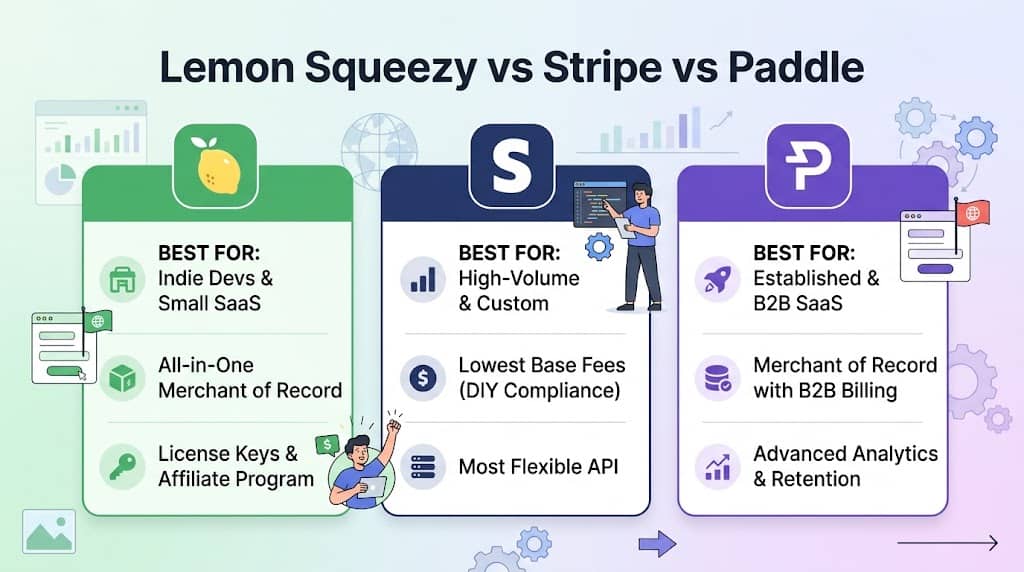
The digital payments landscape in 2025 is richer — and more confusing — than ever. Whether you’re a bootstrapped indie developer shipping your first SaaS product, a creator launching a digital course, or an established software company looking to simplify global tax compliance, the platform you choose to handle payments will directly shape your revenue, your operational overhead, and your customers’ checkout experience.
Lemon Squeezy has earned a devoted following among indie hackers and small SaaS founders since its 2021 launch and its subsequent acquisition by Stripe in 2024. But it is far from the only option, and it is not always the right option. Developers actively searching for Lemon Squeezy alternatives often have very specific reasons — they may need lower fees at scale, more advanced analytics, deeper ERP integrations, or a platform with a longer enterprise track record.
This guide does something most comparison articles don’t: it evaluates each alternative honestly, including Lemon Squeezy’s own weaknesses, so you can make the decision that’s right for your business rather than being nudged toward a sponsored recommendation. We’ll cover Lemonsqueezy vs Stripe, Lemon Squeezy vs Paddle, and every serious contender in between — with real pricing, real feature comparisons, and clear use-case guidance.
1. Why Developers Look for Lemon Squeezy Alternatives
Before diving into the alternatives themselves, it’s worth being transparent about where Lemon Squeezy falls short — because no platform is perfect for every situation.
💸 Fee Sensitivity at Scale
At 5% + $0.50 per transaction, a business processing $500K/year pays ~$25,000 in platform fees alone. Stripe at 2.9% + tax tooling becomes competitive at significant volume.
📊 Analytics Depth
Lemon Squeezy’s native analytics cover core metrics but lack advanced cohort analysis, LTV modeling, and the depth that growing SaaS businesses need for strategic decisions.
🏢 Enterprise Integrations
Native integrations with Salesforce, HubSpot, NetSuite, or sophisticated CPQ tools are limited. Larger organizations often need these out of the box.
🧾 Invoice & Quote Workflows
B2B businesses that send custom invoices, request quotes, or support purchase orders will find Lemon Squeezy’s tooling thin compared to Paddle or FastSpring.
🔌 API Flexibility
Developers who need to build deeply custom billing workflows with complex proration logic or multi-product bundling sometimes hit the edges of what Lemon Squeezy’s API can support.
🌏 Payment Method Coverage
Businesses with large customer bases in Southeast Asia or the Middle East may need local payment methods that Lemon Squeezy doesn’t yet support natively.
That said, for most indie developers and small SaaS businesses, these limitations are theoretical rather than practical. The decision ultimately comes down to your current stage, your customers’ geography, and how much compliance work you’re willing to own yourself.
2. All the Platforms at a Glance
Here’s a rapid-fire summary of every serious Lemon Squeezy alternative we’ll cover in this guide, along with the one-line positioning of each:
| Platform | MoR? | Monthly Fee | Txn Fee | Best For |
|---|---|---|---|---|
| 🍋 Lemon Squeezy | ✅ Yes | $0 | 5% + $0.50 | Indie devs, small SaaS, creators |
| ⚡ Stripe | ❌ No | $0 | 2.9% + $0.30 | Developers, high volume, custom builds |
| 🏓 Paddle | ✅ Yes | $55+/mo | 5% + $0.50 | Established SaaS, B2B software |
| 🌸 Gumroad | ✅ Yes | $0 | 10% | Creators, simple digital goods |
| 🌱 FastSpring | ✅ Yes | Custom | 8.9%–5.9% | B2B software, desktop apps, enterprise |
| 💜 Payhip | ✅ Yes | $0–$99 | 0%–5% | Budget creators, small stores |
3. Stripe — The Developer’s Raw Powerhouse
Stripe
stripe.com · Founded 2010 · Publicly estimated $65B+ valuation
Stripe is the gold standard for developer-built payment systems. It is not, however, a Merchant of Record — and that’s the most important distinction when comparing Lemonsqueezy vs Stripe. When you use Stripe, you are the seller. You are responsible for every dimension of tax compliance, fraud handling, and regulatory filing.
What Stripe does offer is unmatched API flexibility. The Stripe API is arguably the most powerful, best-documented payment API in existence. You can build virtually any billing model on top of it — metered billing, usage-based SaaS, multi-party marketplaces, complex B2B invoicing, or even physical retail. Stripe’s ecosystem also includes Stripe Tax (for automated tax calculation), Stripe Billing (for subscriptions), and Stripe Radar (for fraud detection) — but each of these is a separate add-on layer, not a bundled all-in-one solution.
✅ Stripe Strengths
- Industry-leading API & documentation
- Lowest base transaction fee (2.9% + $0.30)
- Most flexible billing model support
- 135+ payment methods globally
- Stripe Connect for marketplace builds
- Extremely mature fraud detection (Radar)
- Excellent developer tooling & test mode
❌ Stripe Weaknesses
- Not a Merchant of Record
- You handle all tax compliance
- No built-in storefront or product pages
- No license key management
- No affiliate program
- Significant dev time required to launch
- Chargebacks are your responsibility
Real-world cost of Stripe: The 2.9% + $0.30 fee sounds cheaper than Lemon Squeezy’s 5% + $0.50. But add Stripe Tax ($0.50 per transaction or a monthly fee), Stripe Billing (0.5% of recurring revenue), and either Avalara or TaxJar for proper international tax compliance ($20–$500/month), and the gap closes dramatically — often disappearing entirely for businesses under $250K/year in revenue.
🎯 Choose Stripe if:
You have a dedicated developer (or are one), are comfortable owning your own tax compliance, need maximum flexibility in how you implement billing, or are building a product at a scale where even 1% fee reduction is worth the operational overhead it introduces.
4. Paddle — The Enterprise-Grade MoR
Paddle
paddle.com · Founded 2012 · 3,000+ software companies
Paddle is Lemon Squeezy’s closest structural competitor — it’s also a Merchant of Record built specifically for software companies. The key difference is positioning: while Lemon Squeezy targets indie developers and small teams, Paddle is built for established SaaS businesses that need more powerful billing infrastructure and enterprise-grade support.
When evaluating Lemon Squeezy vs Paddle, the fee structure is the first thing most people notice. Paddle charges a similar 5% + $0.50 per transaction, but adds a minimum platform fee (historically starting around $55/month) on top. For small businesses just getting started, this monthly commitment is a real barrier. For a company doing $30K+ per month, it’s largely irrelevant relative to the more advanced features Paddle provides.
Where Paddle genuinely pulls ahead of Lemon Squeezy is in its B2B billing capabilities. Paddle Billing (their newer product, which replaced the legacy Paddle Classic) includes:
- Seat-based and usage-based billing models
- Custom pricing and private deals for enterprise customers
- Sophisticated trial and discount logic
- ProfitWell Metrics integration (advanced retention and MRR analytics)
- Retain by ProfitWell (AI-driven churn prevention)
- Dedicated account manager for larger accounts
- Net-30 and invoice payment terms
✅ Paddle Strengths
- Full Merchant of Record coverage
- Advanced B2B billing (seats, usage)
- ProfitWell analytics bundled
- Retain churn reduction tools
- Strong enterprise integrations
- Custom invoicing & net terms
- Longer track record (since 2012)
❌ Paddle Weaknesses
- Monthly platform fee (cost barrier early-stage)
- More complex to set up than Lemon Squeezy
- No built-in affiliate program
- No license key management
- Less creator-friendly storefront
- Paddle Classic → Billing migration friction
- Support can be slower for smaller accounts
🎯 Choose Paddle if:
You’re a software company with $10K+ MRR that needs enterprise billing features, ProfitWell-level analytics, or the ability to do custom enterprise deals. If you’re just starting out, Paddle’s monthly fee makes it harder to justify until you’re generating consistent revenue.
5. Gumroad — The Creator’s Simple Store
Gumroad
gumroad.com · Founded 2011 · 90,000+ creators
Gumroad is one of the oldest names in the digital product space and remains a popular Lemon Squeezy alternative for content creators selling eBooks, courses, music, and design assets. Its primary appeal is radical simplicity — create a product, share a link, get paid. There’s virtually zero setup friction.
However, that simplicity comes at a steep cost. Gumroad’s 10% transaction fee is double Lemon Squeezy’s, and the platform offers far fewer features for software developers specifically. There’s no license key management, the subscription system is basic, and analytics are surface-level. For a creator selling a $15 eBook where volume is low, the 10% fee is manageable. For a developer selling a $499/year SaaS subscription, that same fee rate is deeply painful.
🎯 Choose Gumroad if:
You’re a content creator (not a developer), you want the absolute fastest path from zero to selling, and your transaction volume or price points don’t make the 10% fee prohibitive. For software products or subscriptions, it’s rarely the right choice.
6. FastSpring — The B2B Software Veteran
FastSpring
fastspring.com · Founded 2005 · B2B software specialist
FastSpring is arguably the most battle-tested Merchant of Record in this comparison — it’s been doing this since 2005, predating Stripe by five years. It’s purpose-built for B2B software businesses and handles everything from global tax compliance to sophisticated pricing models, volume discounts, and quote-based selling.
FastSpring’s pricing model is tiered: the “growth” tier charges 8.9% per transaction, stepping down to 5.9% as your volume increases. For many early-stage businesses, this is more expensive than Lemon Squeezy, but the platform includes robust capabilities that justify the premium for the right buyer. Notably, FastSpring excels at B2B enterprise quoting, reseller support, and deep reporting that growing software companies need.
The tradeoff is that FastSpring’s onboarding is considerably more complex than Lemon Squeezy’s, the interface feels less modern, and it’s clearly designed for software companies with dedicated ops teams rather than solo founders. If you’re looking for a straightforward Lemon Squeezy alternative that you can set up in an afternoon, FastSpring probably isn’t it.
🎯 Choose FastSpring if:
You run a B2B desktop software business with volume pricing needs, require reseller/channel partner support, or need deeply customized checkout experiences with localized pricing and volume discounts for enterprise buyers.
7. Payhip — The Budget-Friendly Option
Payhip
payhip.com · Free to $99/month · EU VAT handled
Payhip is the budget-conscious creator’s platform, offering a free plan with a 5% transaction fee, a “Plus” plan at $29/month with 2% fee, and a “Pro” plan at $99/month with 0% transaction fee. It covers EU VAT compliance and supports digital downloads, memberships, coaching, and online courses.
Payhip is a legitimate and well-run platform, but its global tax coverage is less comprehensive than Lemon Squeezy’s, and it lacks the developer-focused features like license key APIs or a robust webhook system. It’s ideal for creators in the UK and EU who sell simpler digital products and want to keep costs low on smaller volumes.
🎯 Choose Payhip if:
You’re a creator in the UK or EU selling digital goods on a tight budget, don’t need license keys or complex subscription logic, and want to graduate to zero transaction fees once you reach stable volume by moving to the Pro plan.
8. Head-to-Head: Full Feature Comparison Table
No amount of prose beats a side-by-side table when you’re making a platform decision. Here’s the most comprehensive comparison of every feature that matters to digital product sellers and SaaS businesses.
| Feature | 🍋 Lemon Sq. | ⚡ Stripe | 🏓 Paddle | 🌸 Gumroad | 🌱 FastSpring | 💜 Payhip |
|---|---|---|---|---|---|---|
| Merchant of Record | ✅ | ❌ | ✅ | ✅ | ✅ | ⚠️ EU only |
| Global Tax Filing | ✅ | ❌ | ✅ | ✅ | ✅ | ⚠️ Partial |
| Monthly Platform Fee | $0 | $0 | $55+ | $0 | Custom | $0–$99 |
| Base Transaction Fee | 5% + $0.50 | 2.9% + $0.30 | 5% + $0.50 | 10% | 5.9%–8.9% | 0%–5% |
| Subscription Billing | ✅ Built-in | ⚠️ Add-on | ✅ Advanced | ⚠️ Basic | ✅ Advanced | ⚠️ Basic |
| License Key Management | ✅ | ❌ | ❌ | ❌ | ✅ | ❌ |
| Affiliate Program | ✅ | ❌ | ❌ | ✅ | ❌ | ✅ |
| Built-in Storefront | ✅ | ❌ | ⚠️ Limited | ✅ | ⚠️ Embed only | ✅ |
| Overlay Checkout | ✅ | ✅ Custom | ✅ | ❌ | ✅ | ❌ |
| Dunning Management | ✅ | ⚠️ Basic | ✅ Advanced | ❌ | ✅ | ❌ |
| WooCommerce Plugin | ✅ | ✅ Official | ✅ | ❌ | ❌ | ❌ |
| Ease of Setup (1–10) | 9/10 | 6/10 | 7/10 | 10/10 | 4/10 | 9/10 |
9. Lemon Squeezy vs Stripe: The Deep Dive
The Lemonsqueezy vs Stripe decision is probably the most debated comparison in the indie developer community, and understandably so — these two platforms represent fundamentally different philosophies about what a payment platform should be.
Lemon Squeezy Philosophy
“We handle everything.
You just build.”
Stripe Philosophy
“Maximum power.
You configure everything.”
Fee Comparison at Real-World Revenue Levels
Let’s do the math that most comparison articles skip. We’ll model a SaaS business selling a $49/month subscription:
| Monthly Revenue | Lemon Squeezy Cost | Stripe + Tax Compliance | Winner |
|---|---|---|---|
| $1,000/mo (20 customers) | ~$60 | ~$49 + $29 tax tool = ~$78 | 🍋 LS |
| $10,000/mo (204 customers) | ~$600 | ~$490 + $99 tax tool = ~$589 | ⚡ ~Tie |
| $50,000/mo (1,020 customers) | ~$3,010 | ~$2,490 + $299 tax = ~$2,789 | ⚡ Stripe |
| $200,000/mo (4,082 customers) | ~$12,040 | ~$9,960 + $499 tax = ~$10,459 | ⚡ Stripe |
*Estimates based on typical Stripe Tax or Avalara pricing. Actual costs vary. Stripe Billing’s 0.5% recurring fee not included above; adding it narrows the gap further at high volume.
The takeaway from this analysis is clear: for businesses under roughly $10K MRR, Lemon Squeezy is cost-competitive with or cheaper than Stripe when you factor in the full cost of the compliance stack. Above that threshold, Stripe’s lower base rate starts to compound into meaningful savings — but only if you’re willing to invest in the tax infrastructure and developer time that the self-managed approach requires.
Developer Experience
In a pure Lemonsqueezy vs Stripe API comparison, Stripe wins decisively on raw capability. Stripe’s API has been refined over 15 years and supports use cases Lemon Squeezy’s API can’t yet match — including metered billing, complex proration scenarios, multi-currency subscription pricing with automatic FX, and fine-grained webhook filtering. If you’re a developer who thinks in API payloads and wants to build a bespoke billing system, Stripe is the tool.
However, Lemon Squeezy’s API is purposefully scoped — and for 90% of indie developers, that scope covers everything they need. The webhook system is clean, the REST API is well-documented, and the deployment path from “I have an idea” to “I’m accepting payments” is measured in hours rather than days or weeks.
10. Lemon Squeezy vs Paddle: The Deep Dive
When comparing Lemon Squeezy vs Paddle, you’re comparing two Merchant of Record platforms with similar core propositions but very different audiences. Both handle global tax compliance, both offer subscription billing, and both charge 5% + $0.50 per transaction. But the similarities end there.
🍋 Lemon Squeezy
Built for
Indie developers, bootstrapped founders, creators, and small SaaS teams who want to start fast with zero upfront cost.
Standout Features
- License key generation & API
- Built-in affiliate program
- Overlay & hosted checkout modes
- $0 monthly fee — pay only on sales
- WooCommerce integration plugin
- Stripe-backed infrastructure (2024+)
🏓 Paddle
Built for
Established software companies, B2B SaaS, and teams that need advanced billing models and enterprise-grade analytics.
Standout Features
- Seat-based & usage-based billing
- ProfitWell Metrics (MRR/LTV/churn)
- Retain — AI churn prevention
- Custom enterprise pricing deals
- Net-30 invoice payment terms
- Dedicated account management
The Monthly Fee Barrier in Lemon Squeezy vs Paddle
The single most practically impactful difference in the Lemon Squeezy vs Paddle comparison is Paddle’s minimum monthly fee. For a developer who’s pre-revenue or in early traction (under $1K MRR), paying $55+/month to Paddle before you’ve proven product-market fit is a real psychological and financial barrier. With Lemon Squeezy, you pay nothing until you make a sale — zero risk to start.
Once you’re above roughly $5,000 MRR, the monthly fee becomes a much smaller proportion of overall cost, and Paddle’s advanced analytics and billing features start to be worth the premium. The common pattern among software entrepreneurs is to launch on Lemon Squeezy, validate the business, and then evaluate whether Paddle’s additional capabilities justify a migration at the $10K–$25K MRR threshold.
Which Has Better Analytics?
Paddle wins on analytics depth, primarily due to ProfitWell Metrics (which Paddle acquired in 2022). ProfitWell provides cohort analysis, LTV calculations, plan-level churn rates, and MRR movement reporting that goes far beyond Lemon Squeezy’s standard dashboard. If your business decisions live and die by subscription metrics, this is a meaningful advantage.
That said, Lemon Squeezy’s revenue charts and order analytics are entirely sufficient for a business under $50K MRR where decisions are driven more by qualitative feedback than statistical significance. And for deeper analytics, both platforms integrate with external tools via webhooks and APIs.
11. Decision Matrix: Which Platform Fits You?
Stop guessing. Use this decision matrix to identify the right platform for your specific situation.
🧑💻
Indie Developer / Solo Founder
Pre-revenue to ~$5K MRR. Building your first SaaS, plugin, or digital product.
✅ Use Lemon Squeezy
⚙️
Developer Who Owns Everything
You want maximum control, custom billing logic, and are comfortable managing tax compliance yourself.
✅ Use Stripe
🏢
Established SaaS Business
$10K+ MRR. Need ProfitWell analytics, seat-based pricing, and enterprise deal support.
✅ Use Paddle
🎨
Content Creator (Simple Goods)
Selling eBooks, PDFs, music, templates. Lowest possible setup friction is the priority.
✅ Use Gumroad
💰
Budget-Conscious EU Creator
Small volume, primarily EU customers, want $0 transaction fees at the Pro tier.
✅ Use Payhip
🖥
B2B Desktop Software Company
Selling desktop apps with volume licensing, reseller channels, and enterprise quoting needs.
✅ Use FastSpring
12. Already Using WooCommerce? Bridge the Gap
If you’ve been running a WooCommerce store and are evaluating Lemon Squeezy alternatives — or Lemon Squeezy itself — you might be wondering whether switching means rebuilding your entire product catalog and customer database from scratch. The good news is: it doesn’t have to.
For WooCommerce store owners specifically, there’s an elegant middle-ground solution that lets you keep your existing WordPress infrastructure while unlocking Lemon Squeezy’s payment processing, MoR coverage, and subscription management capabilities. The Lemon Squeezy Checkout for WooCommerce plugin, developed by Dominopress, acts as a native bridge between the two platforms.
🍋
Lemon Squeezy Checkout for WooCommerce
By Envoy Digital · v1.1.0 · Requires WooCommerce 7.0+
Instead of migrating away from WooCommerce entirely, this plugin lets you keep managing your products in the WooCommerce backend you already know — and simply route payments through Lemon Squeezy for tax-compliant, subscription-capable checkout.
🪟 Dual Checkout Modes
Choose between a seamless overlay modal on your WooCommerce page or a fully hosted Lemon Squeezy checkout page.
📊 Sales Analytics Dashboard
Interactive ApexCharts-powered revenue dashboards built directly into your WordPress admin.
🔄 Subscription Management
Full subscription dashboard with billing timelines, trial status tracking, and itemized subscription views.
🏷 Discounts Management
Create, list, and delete Lemon Squeezy discount codes from within the WordPress admin panel.
🎨 Checkout Customization
Full control over checkout colors, logo, product description visibility, media, and discount fields from WP Settings.
⚡ HPOS Compatible
Fully declares WooCommerce High-Performance Order Storage compatibility for optimized database performance.
How the checkout flow works:
- Customer adds a Lemon Squeezy-mapped product to their WooCommerce cart
- At checkout, the Lemon Squeezy payment gateway appears automatically
- Customer places order → plugin generates a Lemon Squeezy checkout URL with customer details pre-populated (name, email, billing country)
- In Overlay mode: the Lemon Squeezy modal opens directly on your WooCommerce checkout page — no redirect
- Payment completes → webhook fires → WooCommerce order status updates automatically
- Customer lands on your WooCommerce Thank You page
What makes this plugin particularly compelling for WooCommerce store owners evaluating their options is the real-world alternative cost. Migrating a WooCommerce store with hundreds of products, existing customer accounts, and custom integrations to any standalone platform — whether Lemon Squeezy, Paddle, or another — is a significant project. The plugin eliminates that migration entirely, letting you add Lemon Squeezy’s tax compliance and checkout experience as a layer on top of what you already have.
For store owners who’ve looked at the Lemon Squeezy alternatives landscape and decided Lemon Squeezy is the right fit but don’t want to abandon their WooCommerce investment, this is genuinely the best path forward. And compared to the WooCommerce plugins offered for Stripe or Paddle, it brings the full suite of Lemon Squeezy features — subscriptions, discounts, analytics, customization — directly into the WordPress admin in a clean, modern React-powered interface.
13. Final Verdict: Which Platform Wins?
There’s no universal answer to which payment platform is best — the winner depends entirely on your stage, your audience, and how much compliance work you’re willing to own. But here’s our honest, opinionated summary after a thorough evaluation of every major Lemon Squeezy alternative:
🍋
Lemon Squeezy
BEST FOR MOST INDIE DEVS
Zero monthly fee, MoR coverage, license keys, affiliates, and subscriptions. The most complete all-in-one for small digital product businesses.
⚡
Stripe
BEST FOR HIGH-VOLUME / CUSTOM
Cheapest base fee, maximum API flexibility. The right choice once your MRR justifies owning the compliance stack.
🏓
Paddle
BEST FOR ENTERPRISE SAAS
ProfitWell analytics, seat-based billing, enterprise deals. Worth the monthly fee when you’re scaling past $10K MRR.
If we had to give a single recommendation for the developer who’s just launching their first paid product today — and who doesn’t have a compliance team, a DevOps budget, or months to build a billing system from scratch — Lemon Squeezy remains the standout choice. The fee model is fair, the setup is fast, and having Stripe’s infrastructure behind it as of 2024 removes the last major concern about platform stability.
For those already running on WooCommerce, remember: you don’t have to choose between WooCommerce and Lemon Squeezy. The Lemon Squeezy Checkout for WooCommerce plugin by Envoy Digital turns this into a both/and decision — keep the WooCommerce infrastructure you’ve built, and add Lemon Squeezy’s world-class checkout and compliance layer on top of it. That’s arguably the most practical and lowest-risk path for any WordPress-based digital product business.
| Platform | Ease | Value | Features | Compliance | Overall |
|---|---|---|---|---|---|
| 🍋 Lemon Squeezy | 9.0 | 8.8 | 9.0 | 9.5 | 9.1 ⭐ |
| ⚡ Stripe | 6.0 | 8.5 | 9.5 | 5.0 | 7.5 |
| 🏓 Paddle | 7.0 | 7.5 | 9.0 | 9.5 | 8.4 |
| 🌸 Gumroad | 9.5 | 6.0 | 6.0 | 8.0 | 7.4 |
| 🌱 FastSpring | 4.5 | 7.0 | 8.5 | 9.5 | 7.4 |
| 💜 Payhip | 9.0 | 8.5 | 6.5 | 6.5 | 7.6 |
Ready to Make Your Move?
Start Selling Smarter Today
Whether you’re starting fresh on Lemon Squeezy or bridging it with your existing WooCommerce store, getting started takes less than an afternoon.
